
India takes a green leap with its first hydrogen train
Deep Tech Dispatch Issue #17 | A newsletter from India Tech Report

Hi, wherever you’re reading this, I hope you’re doing well.
First, a few headlines that caught my attention, from the government’s Press Information Bureau.
Ultrafast organic anodes designed for next-generation rechargeable batteries
The Lede
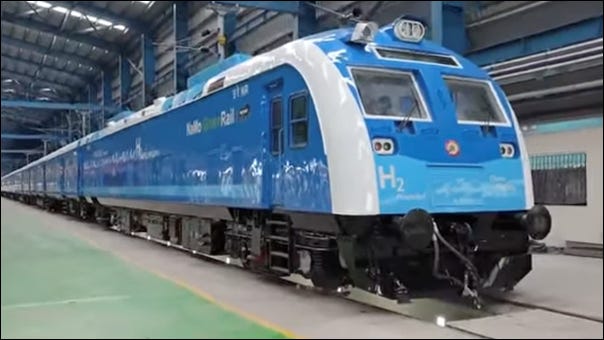
Indian Railways gets its first hydrogen fuel cell powered train
The modernisation of Indian Railways has hitherto relied on continual expansion of overhead electrification of its vast broad-gauge network. The state-run network is now charting a more autonomous path toward decarbonization.
Prime Minister Narendra Modi flagged off the country’s first hydrogen fuel cell powered trainset, at Jind from where the train will make a 90 km journey to Sonipat, both towns in the northern Indian state of Haryana.
The fuel cell technology, using a proton-exchange electrolyser, generates electricity through an electrochemical reaction between hydrogen and atmospheric oxygen. The electricity is stored in lithium-ion batteries, which will power the train’s electric engine.
The project seeks to demonstrate that clean rail mobility can be achieved without relying entirely on an external power grid.
This new trainset (locomotives + trailer cars) revives the historical operational independence of steam and diesel locomotives — albeit with water vapour as its only by-product. Built using indigenous technology integrated by Medha Servo Drives and the Integral Coach Factory, the configuration features two driving power cars delivering 1,200 kW of power, pulling eight trailer coaches.
Capable of carrying roughly 2,600 passengers at design speeds of up to 110 kilometres per hour, the initiative marks a significant structural scaling up of a propulsion system that has hitherto been confined to much smaller regional deployments.
The deployment comes as rail operators worldwide face intensifying pressure to eliminate fossil fuels and meet strict national net-zero targets. While early adoption of hydrogen passenger trains has been concentrated in Europe—most notably in Germany — and via pilot programmes in China and Japan, these initiatives have generally been confined to modest two- or three-coach configurations.
India’s venture represents a bolder bet on the scale and commercial viability of high-capacity hydrogen transit, backed by the establishment of the country’s largest dedicated railway hydrogen refuelling facility at Jind to support continuous, regular operations.
“Most hydrogen passenger trains currently operating globally comprise only two or three coaches and are primarily deployed on short regional routes,” the Ministry of Railways noted in a press release yesterday. “In contrast, the Indian Railways trainset has been configured as a 10-coach passenger train with a capacity of around 2,600 passengers, demonstrating the scalability of hydrogen-powered rail transport for high-capacity passenger operations.”
Safety concerns, because of the highly combustible nature of hydrogen gas, and the steep infrastructure costs required to grow and sustain these trains are two important challenges.
To manage the safety risks inherent to handling a highly flammable, odourless gas, the network has implemented a multi-layered “defence in depth” safety system, certified by Germany’s TÜV SÜD. The ecosystem includes continuous leak detection, automatic fuel shut-offs, and specialised ventilation systems.
If the Jind–Sonipat trials prove commercially reliable, the railway ministry plans to expand the rollout to heritage lines such as the Kalka–Shimla route, marking a calculated transition from a novelty pilot to a core pillar of India’s broader National Green Hydrogen Mission.
If you missed the latest Conversations episode
Mredul Sarda’s journey from student satellite to deep tech investor to cybersecurity entrepreneur

In this episode, I’m joined by Mredul Sarda, an operator-investor in early-stage deep tech and now a cybersecurity entrepreneur.