
India’s deep tech has a Series A problem and other takeaways from a conversation with Ideaspring’s founders
Deep Tech Dispatch Issue #7 | A newsletter from India Tech Report

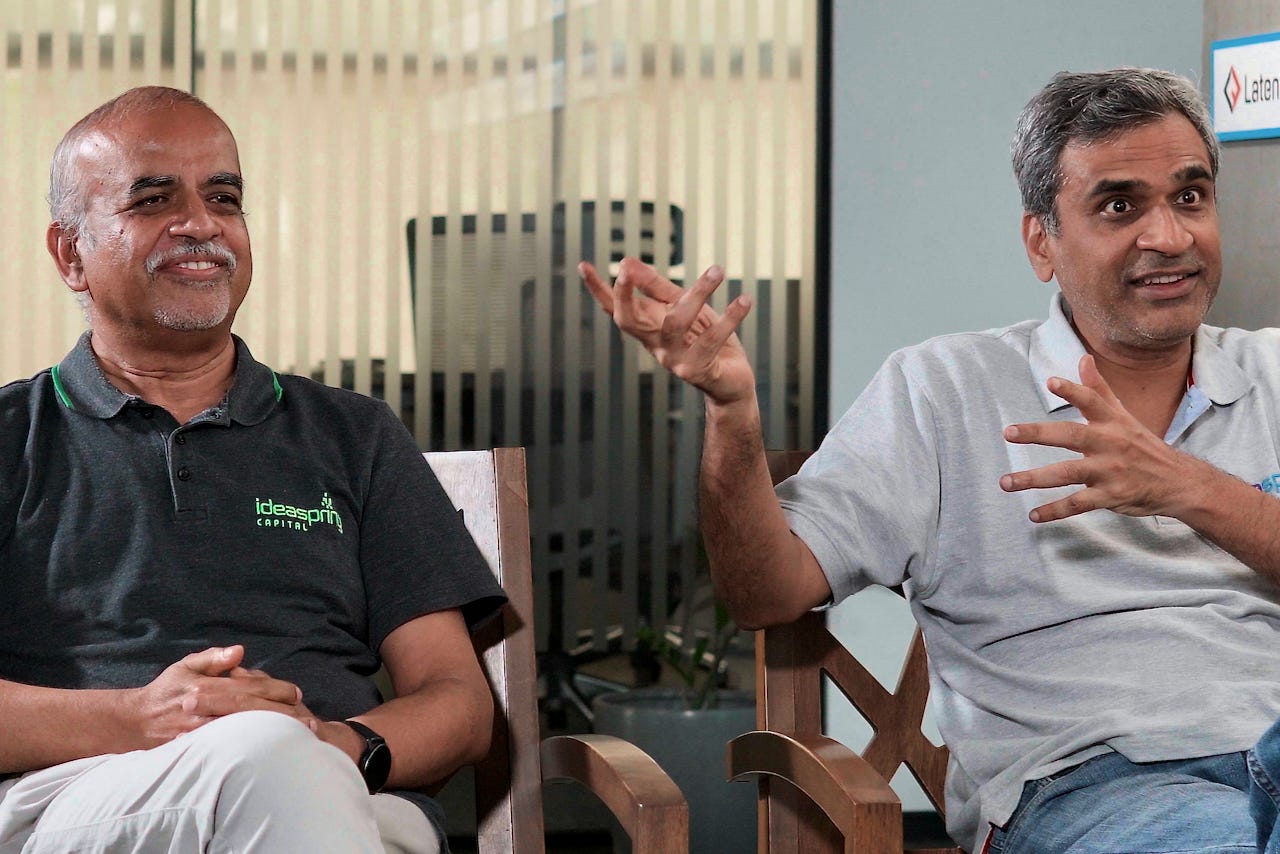
In my recent interview with Naganand Doraswamy, managing partner, and Suryaprakash Konanuru, CTO at Ideaspring Capital, a VC firm the former serial entrepreneurs started more than 10 years ago, we touched upon a range of topics on India’s deep tech landscape.
You can find the interview in two parts. Here below are my top takeaways from Part 1.
Why Ideaspring chose to lead the investment in HrdWyr
Ideaspring led the $13 million Series A for HrdWyr because the semiconductor startup aligns perfectly with their thesis of addressing India’s $18-20 billion chip import problem. This presents an opportunity for companies such as HrdWyr to address a strategic vulnerability with designed-in-India solutions.
HrdWyr, which has just announced its first chip, focuses on power management for white goods, chargers, and brushless motors, offering a practical path to replacing imports before eventually scaling all the way to complex data centre chips. The startup’s founders Ramamurthy Sivakumar and Ganesh Guruswamy are veterans of the industry, having worked in companies including Intel, AMD, Motorola and Sandisk.
The investment is also highly capital-efficient for a VC firm the size of Ideaspring, which can’t make Silicon Valley style bets of tens or hundreds of millions of dollars. HrdWyr fits Ideaspring’s budget while solving immediate local problems – a playbook for all Indian deep tech VCs, pretty much.
The rapid evolution of India’s deep tech ecosystem
There is a dramatic shift in the quality and quantity of deep tech startups compared with when Ideaspring launched in 2016. During their first fund, only three or four out of sixteen investments truly qualified as deep tech or science-based, as the ecosystem primarily offered B2B software applications.
By Fund II, this ratio shifted significantly to eleven deep tech companies out of seventeen investments. Their third fund is expected to consist almost entirely of deep tech or science-focused startups, reflecting a maturing pipeline of researchers and domain experts.
While early AI startups often focused on simple applications of existing models, today’s entrepreneurs are conducting more fundamental research in sectors such as semiconductors and biotech.
This progression validates their long-held thesis that India is capable of building world-class products, even as one has to remain realistic about the capital and market challenges ahead.
“But I’m still very concerned about Series A investments from funds outside of India. That’s a weak point for us.“
Naganand Doraswamy
Establishing sustainable technology moats in the age of AI
Suryaprakash, an enterprise software veteran himself, points out that building simple applications on top of existing deep tech is no longer sufficient because advanced models like those from Anthropic, for example, can easily absorb those functions. To establish a true “moat” or differentiator, Ideaspring seeks startups grounded in ten to fifteen years of research.
The paradigm of software development has fundamentally changed; what once required a twenty-person team and months of work can now be achieved by a few people in weeks or less. This acceleration forces investors to look for specialized differentiators like Small Language Models (SLMs) or unique physics-based models that cannot be quickly replicated.
The software industry is “going through a metamorphosis,” Naganand notes, with new and more capable AI features being released literally every day. AI will be an increasingly more powerful enabler, but the investment focus is now clearly on areas such as semiconductors and biotech, where founders with deep domain expertise can go after potential large local and eventually global opportunities.
Navigating the hurdles of domestic procurement and market risk
A significant challenge for Indian deep tech is not necessarily the size of the domestic market per se, but the risk-averse nature of local procurement. While policy intentions are strong, decision-makers at the ground level are often forced to follow extant rigid guidelines that prohibit buying from startups which by their very nature can’t offer long histories or massive revenues.
A cultural shift is required where purchasing officers are encouraged to take calculated risks on local innovation rather than defaulting to established global companies. Encouragingly, the government’s Research and Development Innovation Fund (RDIF) is helping by increasing the survival runway and credibility of these startups.
When buyers see a startup has sufficient capital to survive and service its products, their confidence increases. However, for the ecosystem to truly thrive, the private sector and defense procurement must open up more quickly, providing the necessary market pillar alongside talent and capital to complete the innovation cycle.
Addressing the capital gap and the Series A weak point
Naganand identifies Series A funding as a critical “weak point” for Indian deep tech because foreign funds are often nervous about investing in companies domiciled in India at that specific growth stage. While seed funding is robust and Series B investors focus more on scale than location, the Series A gap remains a challenge for startups looking to cross the growth cusp.
Domestically, raising capital from local Limited Partners (LPs) is difficult due to general risk aversion and a lack of understanding regarding the long, twelve-year cycles of venture capital. Many family offices prefer more liquid investments or real estate over startup funding.
The investors argue that India urgently needs to increase its innovation spend from 0.7 percent of GDP to 3 percent to avoid being a technological laggard. They welcome international capital at any stage, and especially at the Series A level, believing that more competition and infusion of funds ultimately benefit the entire ecosystem.