
Indian scientists advance zinc-ion battery tech, Minister Vaishnav opens US manufacturer Jabil’s Pune hub
Deep Tech Dispatch Issue #13 | A newsletter from India Tech Report

Hi,
Wherever you’re reading this, I hope you’re doing well. Thank you for supporting my work by being a subscriber. It means a lot.
The Lede
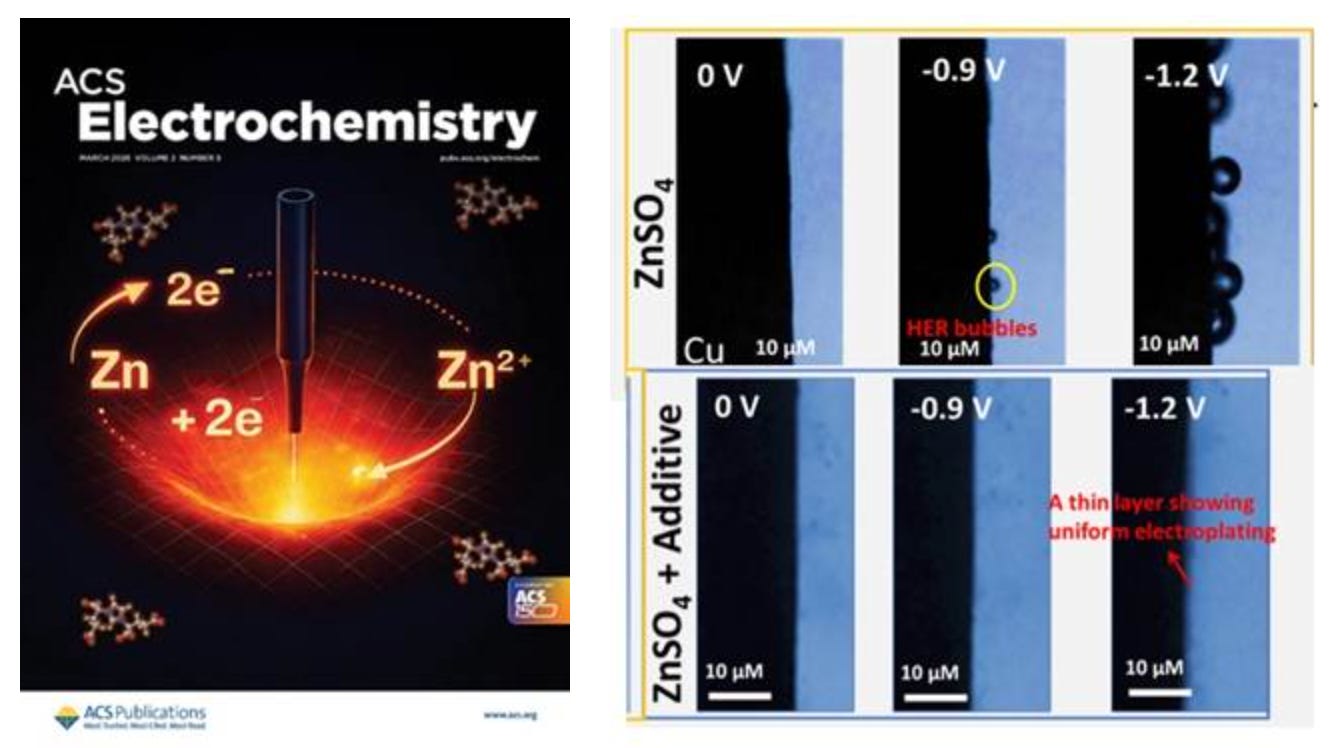
Indian scientists develop an electrolyte additive to improve commercial viability of zinc-ion batteries
Indian researchers have reported an electrolyte additive that could make aqueous zinc-ion batteries safer, longer-lasting and more affordable, a modest but potentially useful advance for large-scale energy storage. The work, led by scientists at the Institute of Nano Science and Technology under the Department of Science and Technology, targets the interface problems that have slowed commercial adoption.
Aqueous zinc batteries have long looked like a practical alternative to lithium-ion systems because they use cheaper materials and are inherently safer, but their promise has been blunted by dendrite growth, corrosion and hydrogen evolution. The new approach does not rely on expensive redesigns of the battery itself; instead, it uses a small additive, BDIM, to alter surface behaviour where the chemistry matters most.
The broader significance lies in the world’s urgent search for grid storage that is inexpensive, durable and easy to scale as renewables expand. If zinc-based batteries can be made to last longer without sacrificing safety, they could find a niche in backup power, renewable integration and other stationary applications where cost and reliability matter more than energy density.
“BDIM selectively adsorbs on zinc metal surfaces and regulates the Inner Helmholtz Plane of aqueous zinc ion batteries,” the release says, describing the mechanism behind the advance. It adds that the additive displaces water molecules at the interface, reducing hydrogen evolution, corrosion and dendrite formation. The research, led by Dr Ramendra Sundar Dey, has been published in ACS Electrochemistry.
The practical appeal is clear: an incremental materials fix may prove more scalable than a wholesale rethink of battery chemistry. That is the sort of advance energy storage needs, not a breakthrough in search of a market, but a careful engineering tweak aimed at making existing ideas work better.
One other headline
Union Minister Ashwini Vaishnaw inaugurates US manufacturer Jabil’s Pune hub
Union minister Ashwini Vaishnaw inaugurated Jabil’s advanced manufacturing facility and export-focused data centre ecosystem in Pune, highlighting high employment potential and India’s electronics push.
This week’s episode in Conversations
If you missed the latest episode’s release on Tuesday, here’s a chat with Ramamurthy Sivakumar, co-founder and CEO at HrdWyr, a semiconductor startup in Bengaluru.

Custom silicon: Ramamurthy Sivakumar at HrdWyr on the opportunity to build from India for the world
And coming up

That’s it for today. When you have a minute, please would you share this with friends who might be interested in India’s deep tech and climate tech startups. Here’s wishing you a great rest of the day.