
Indian space tech startups have raised $871 million so far across 285 ventures | Tracxn press release
Skyroot’s $150 million raised makes it the sector’s best-funded company, valued above $1.1 billion after its May 2026 round — India’s first space tech unicorn

Hi,
Wherever you’re reading this, I hope you’re doing well. Here’s a quick missive, simply bringing you some numbers on India’s space tech startup funding, courtesy a press release earlier today from Tracxn, a leading provider of private markets intelligence.
Highlights
India’s SpaceTech ecosystem has raised approximately $871 million across 241 funding rounds and 285 companies as of July 2026.
The top 10 funded companies account for more than 60 percent of this total, led by Skyroot at $150 million.
Bengaluru leads all hubs with $495 million raised across 106 rounds, and hosts seven of the top 10 funded SpaceTech companies.
Pixxel, the city’s largest funded company, accounts for nearly 19 percent of Bengaluru’s total.
Annual funding rose from $43 million in 2021 to $200 million in 2025, with $113 million raised across 24 rounds already in 2026 year-to-date.
Five landmark rounds — at Skyroot, Digantara, EtherealX, Bellatrix Aerospace, and AgniKul — accounted for $158 million, over half of all capital deployed across 2025–26.
Skyroot’s $150 million raised makes it the sector’s best-funded company, valued above $1.1 billion after its May 2026 round — India’s first SpaceTech unicorn.
Pixxel ($96 million), AgniKul Cosmos ($76 million), and Digantara ($67 million) are among the other leading funded companies in the ecosystem.
Hyderabad and Chennai round out the leading hubs, at $205 million and $80 million respectively. Hyderabad’s funding is anchored by Skyroot and Dhruva Space (87 percent of the city’s total), while Chennai’s is almost entirely AgniKul (95 percent).
Press release
28 July 2026 - Tracxn, the global market intelligence platform for private company data, released the India SpaceTech, a comprehensive analysis of India’s private SpaceTech ecosystem. The report maps $871M raised across 241 funding rounds through July 2026, covering companies across launch vehicles, satellite manufacturing, propulsion systems, space situational awareness, earth observation, and downstream analytics.
The ecosystem spans 285 companies, of which 274 remain active and 72 have received institutional equity funding, across launch vehicles, satellite manufacturing, propulsion systems, space situational awareness, earth observation, and downstream analytics. The central finding is that India’s private SpaceTech ecosystem has been shaped by policy reforms, with government-led regulatory changes enabling private participation, attracting institutional capital, and supporting the emergence of India’s first SpaceTech unicorn and privately developed orbital launch vehicle.
Vikram-1 in Orbit: A Six-Year Journey From Policy Reform to Launch
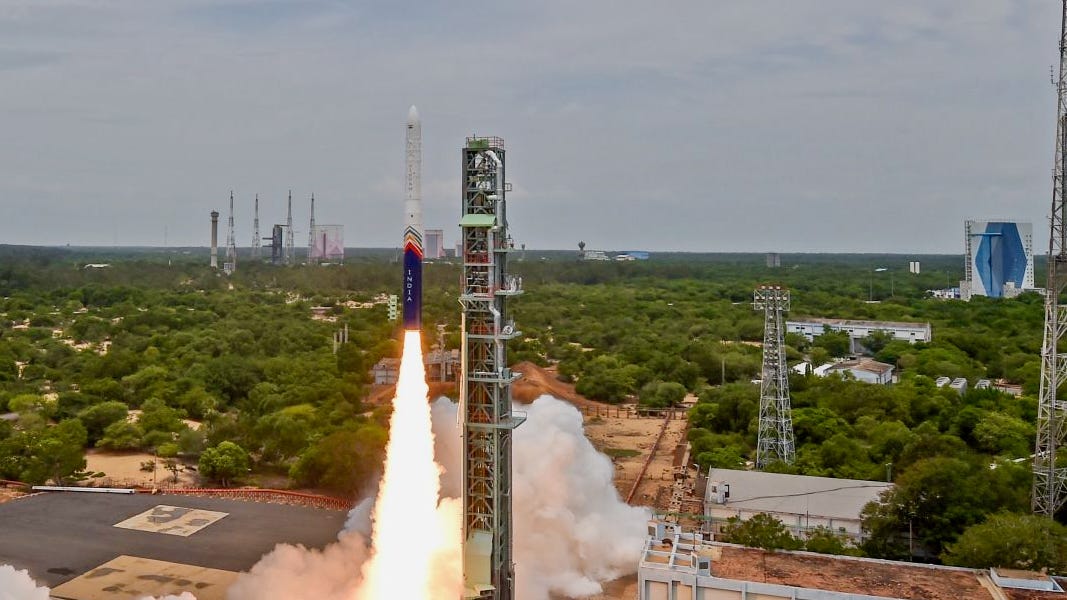
Skyroot’s Vikram-1 reached a 450-kilometre low Earth orbit on July 18, 2026, deploying four payloads, including technology demonstrations from Grahaa Space, Cosmoserve, DCubed, and Skyroot’s SCOPE satellite. The mission made India the third country after the US and China to achieve a privately developed orbital launch capability.
The launch also highlights the pace of ecosystem development. India achieved its first private orbital launch within six years of opening the sector to private participation in 2020. Skyroot plans another test flight later in 2026 before commencing commercial launch operations in 2027.
India SpaceTech Funding Reaches a Record $200M in 2025
Funding increased from $43M across 12 rounds in 2021 to a record $200M across 53 rounds in 2025, with 2026 YTD maintaining strong momentum. Five funding rounds—Skyroot Aerospace ($50M Series C), Digantara ($50M Series B), EtherealX ($21M Series A), Bellatrix Aerospace ($20M Series A), and AgniKul Cosmos ($17M Series C)—collectively contributed $158M, accounting for more than half of the capital raised across 2025 and 2026.
Seed-stage funding increased from $7M in 2022 to $62M in 2025, while late-stage funding emerged for the first time, reaching $17M in 2025 and $53M in 2026 YTD. The investor base has also expanded from domestic venture capital firms and angel investors to sovereign wealth funds and global institutional investors.
Bengaluru Leads India’s SpaceTech Ecosystem with More Than Half of Sector Funding
The top 10 funded companies have collectively raised more than $548M, led by Skyroot Aerospace ($150M), Pixxel ($96M), AgniKul Cosmos ($76M), Digantara ($67M), and Bellatrix Aerospace ($34M). Skyroot became India’s first SpaceTech unicorn following its $50M Series C in May 2026, while Pixxel, AgniKul Cosmos, and Digantara have also attracted significant funding.
Bengaluru leads with $495M across 106 rounds, followed by Hyderabad ($205M) and Chennai ($80M). Together, these three cities account for the majority of equity funding raised by India’s private SpaceTech ecosystem.
You can find Tracxn’s reports on their website.