
India’s climate tech hits $12.8 billion in cumulative funding (Tracxn press release text)
Deep Tech Dispatch Issue #2 | A newsletter from India Tech Report

Tracxn, a global market intelligence platform for private company data, released its India Climate Tech 2026 Report, a comprehensive analysis of an ecosystem where climate action is increasingly tied to India’s energy-security and industrial priorities.
The report examines how funding activity, company formation, investor participation, and policy are developing across India’s climate-tech ecosystem, drawing on Tracxn’s coverage of the sector. It identifies where capital is concentrating, which segments are drawing the widest participation, and how a maturing policy framework is shaping the opportunities available to founders and investors.
Highlights
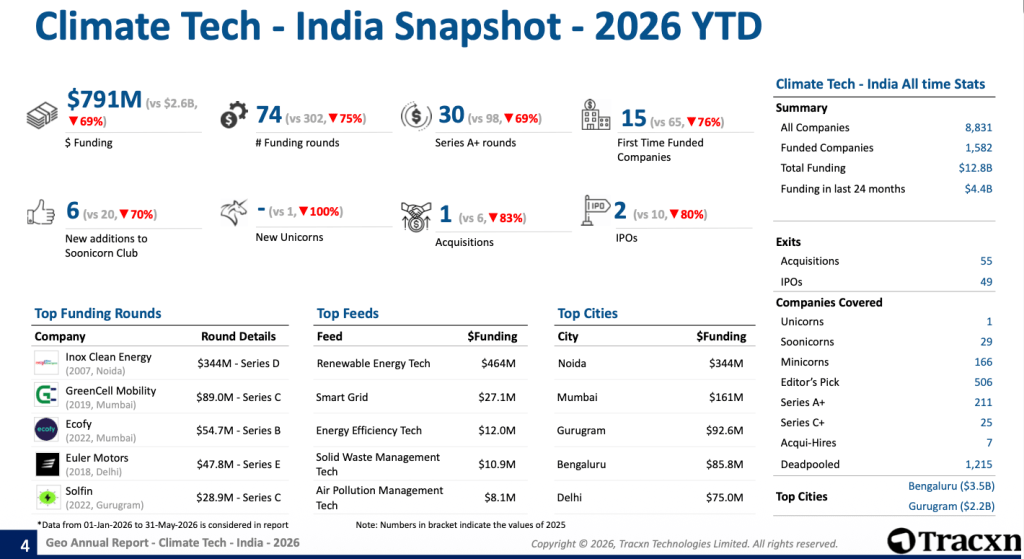
India’s climate-tech companies have attracted approximately $12.8B and 1,583 funded companies, with annual funding rising from about $315M in 2020 to $2.6B in 2025.
Policy, private capital and energy security are converging on the same sectors. With roughly 85% of India’s crude oil imported, renewable energy, electric mobility, batteries and critical minerals now serve both decarbonisation and energy-independence goals.
Capital is consolidating into larger, conviction-led rounds, led by Inox Clean Energy’s $344M Series D (2026) and Erisha E Mobility’s $1B Series D (2025), with development finance institutions such as British International Investment, IFC and FMO actively participating.
Renewable Energy Tech leads cumulative funding at $1.5B, while Solid Waste Management ($477M), Energy Efficiency ($352M), Air Pollution Management ($237M) and Water & Wastewater Management ($208M) show the opportunity broadening across the ecosystem.
2026 YTD funding stands at $791M across 74 rounds, with 66% of funding concentrated in just 5 late-stage rounds, signalling a flight to conviction-led plays.
Policy, Capital and Energy Security Are Aligning
With roughly 85% of India’s crude oil imported, the same technologies — renewable energy, electric mobility, batteries and critical minerals — increasingly address energy security alongside climate goals, giving the investment case two reinforcing drivers. India’s climate-policy framework has moved from supporting technology adoption to building the conditions for large-scale deployment. PM E-DRIVE, a ₹10,900 crore programme extended to 2028, supports electric-vehicle adoption and charging infrastructure; the Carbon Credit Trading Scheme, effective October 2026, establishes a compliance carbon market covering around 490 industrial units across nine sectors; and the Rare Earth Permanent Magnets scheme, a ₹7,280 crore programme, strengthens domestic clean-energy supply chains.
Funding Has Scaled and Is Concentrating in Larger Rounds
Annual funding rose from about $315M in 2020 to $2.6B in 2025, with capital increasingly directed toward larger, conviction-led transactions in electric mobility, renewable energy and energy-transition infrastructure. Landmark rounds include Inox Clean Energy’s $344M Series D in 2026 and Erisha E Mobility’s $1B Series D in 2025. British International Investment participated in three rounds (Euler Motors, GreenCell Mobility and Ecofy), alongside IFC, FMO and Finnfund – reflecting sustained institutional confidence in India’s energy transition.
Renewable Energy Leads, With the Opportunity Broadening
Renewable Energy Tech leads cumulative funding at $1.5B, supported by the capital-intensive nature of renewable-energy and grid infrastructure, with Inox Clean Energy’s $344M Series D and $70M Series C among its notable rounds. Beyond generation, Solid Waste Management Tech ($477M), Energy Efficiency Tech ($352M), Air Pollution Management Tech ($237M) and Water & Wastewater Management Tech ($208M) have together attracted more than $1.2B, pointing to a widening opportunity across resource efficiency, environmental management and industrial sustainability.
As policy support, private capital and energy-security priorities increasingly point to the same set of technologies, India’s climate-tech market is positioned to deepen as well as grow.
2026 YTD: Fewer, Larger, More Conviction-Led Rounds
The first five months of 2026 reflect a market consolidating around scale and conviction, with $791M deployed across 74 rounds. Late-stage activity dominates at $524M across 5 deals, while seed funding stands at $61M across 44 rounds. Noida has emerged as the top funding city. Early-cycle signals remain selective, with 15 first-time funded companies, 6 new Soonicorns, 2 IPOs and 1 acquisition in YTD.