
What’s your best way of keeping track of your serious news? Hint: it doesn’t matter
Ad hoc notes from the field and my workroom

Hi, wherever you’re reading this, I hope you’re doing well.
Today’s topic is one that has engaged me pretty much my entire career, and it’s still work in progress. Read on and you’ll see why.
If I hark back to some years at IDG, almost 20 years ago, it was where one of my then bosses introduced me to the opensource email client Thunderbird, and I loved collecting rss feeds on it. Those few years, that’s how I tried to keep track of news that interested me, companies I tracked, and so on.
Those years were also when I first learnt about podcasts and in fact recorded just the intros, if I remember right, for a small series paid for by IBM, but that’s a story for another time.
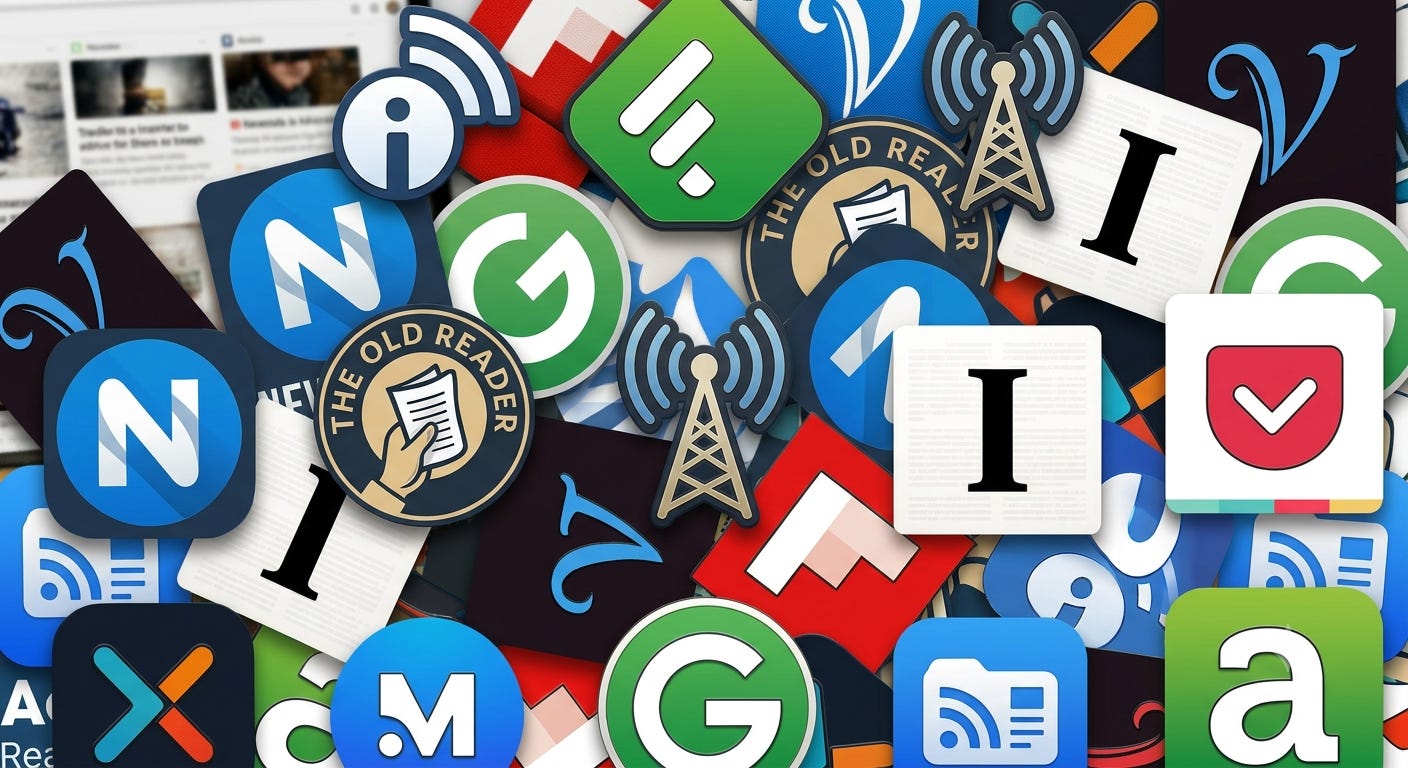
Later for some years, I liked Pocket for a bit. Just googled what happened to, and found out Mozilla acquired it and later shut it down. I also tried Flipboard. Then for some years, Feedly was my go to option, and I actually had a paid subscription. Tried Inoreader too for a short while, and various combinations of Google Alerts, an app called Reeder, for which I still have a subscription on my phone, which is fairly good, by the way, and two other opensource options – Vienna and NetNewsWire.
Both are very good, but I think only NetNewsWire has a mobile app as well, if you like to keep track of your news on multiple devices. I actually end up doing all three, desktop, laptop and mobile, while generally avoiding using a tablet for news and more for entertainment.
And yet
Anyways, here’s the rub. It’s not really what method you use or which app. It’s more about how consistent you can be, if keeping track of news about your companies and the people you’ve covered is important to you – as journos, of course it’s pretty important I’d say. Yet, often, the lazy default option is to simply go to google news and do a random scrolling for a few minutes.
Even within that I’ve set up a bunch of customised searches to keep track of my deep tech and climate tech interests. But I don’t always check them as regularly as I’d like to.
And, for serious LinkedIn users, this is also part of the solution. I regularly save posts that I interest me, but again, not so seriously go back to them. They represent a treasure trove of story ideas, quotes, background information, and even images and videos.
Yes, today, one could build an automated system using AI and refine it on the go. But again, in order to actually benefit from it, one has to slow down to read the copies, make sense of it, and then ask questions, and then we get somewhere. AI can also do a fair bit of this, yes, and it’s probably okay in some spheres depending on what outcome you’re aiming for.
But if your outcome is a genuine deeper understanding of even one domain, company or one person’s work, there’s still no option other than to read. As much as you can. In my case, I also listen as chances are, there will already be a few interviews available online.
Whatever you prefer, it doesn’t matter if your research involves a sophisticated digital app or just reading a couple of newspapers (or even domain-specific newsletters) with a lot focus – consistency is key. Same as in any other endeavour if one wants to become good at it.
Finally, the image and audio clip above is of Mredul Sarda, an early stage deep tech investor who’s now also a cybersecurity entrepreneur. I’ve tracked his work for some years now, although I’d published one previous interview with him, I think. He reached out, saying he was in Bangalore and would I like to meet up. See what I mean? Keep track of your interests and the universe will help you.
Mredul features in the latest episode of my podcast, India Tech Report. Please listen to it. I had fun recording it with just my super handy Sony PCM-A10.
Until next time, thank you and I’d love for you to comment and let me know if this all resonated with you.